For performance reviews
Your next review,
written in one click.
Take two minutes a month to capture what you accomplished — typed or spoken. When review season arrives, TrackRecord turns your record into a polished, manager-ready self-review. Walk in prepared. Walk out recognized.
✓ Every line traces back to an entry you wrote — and you edit everything before anyone else sees it.
Free during the beta — full access, no credit card.
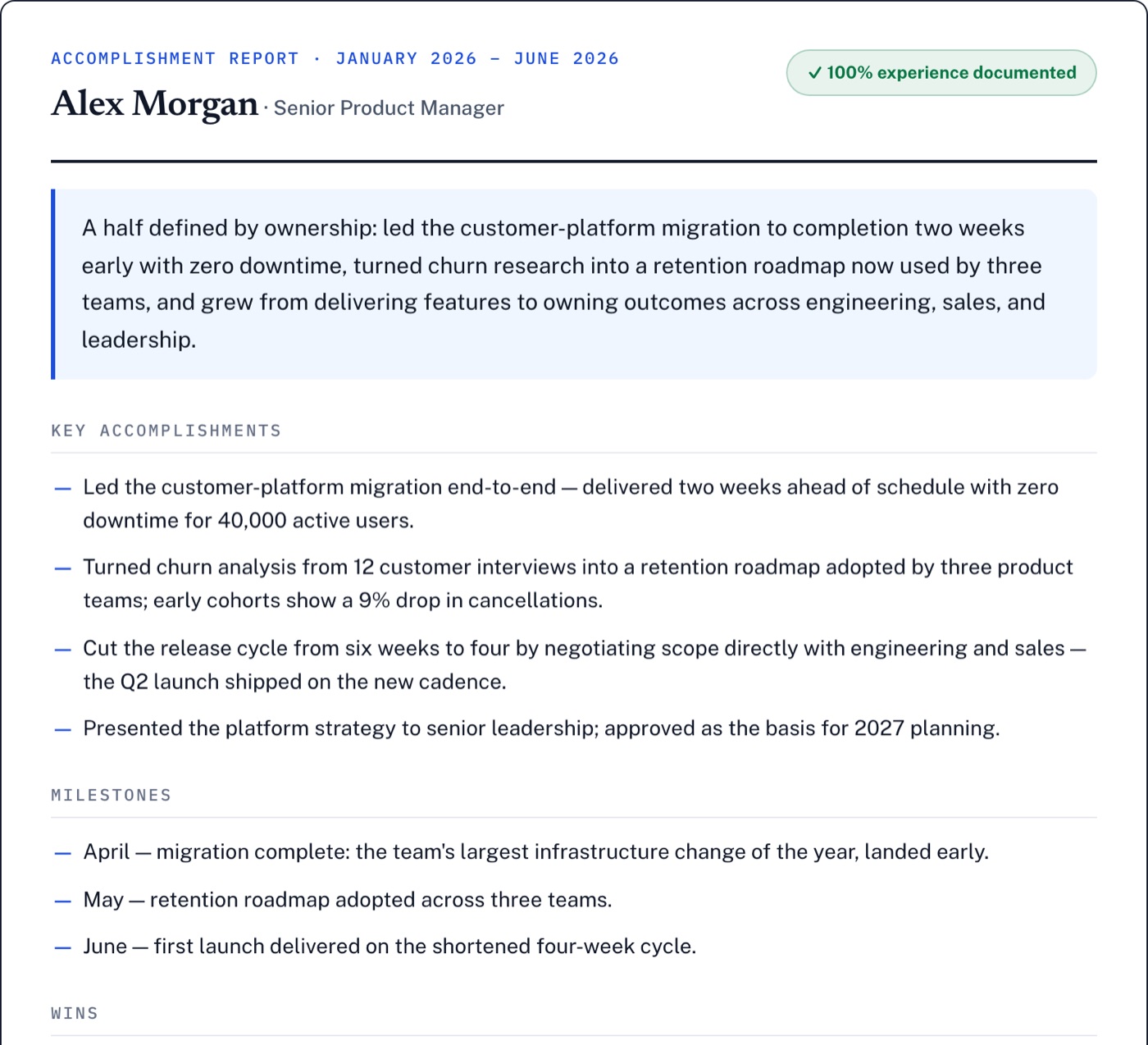
An example report — generated from six months of two-minute check-ins.
This is the whole app.
Your notes on the left. What they become on the right. Nothing hidden behind the sign-in.
Closed out the supplier audit — zero repeat findings, corrective actions signed off two weeks early.
Ran QBRs with our three biggest suppliers; renegotiated lead times that unblocked the Q3 ramp.
Onboarded a new vendor end-to-end — contract, quality agreement, and first PO inside 30 days.
Two minutes in. Everything back out.
One monthly habit feeds a record that answers reviews, promotions, and recruiters alike.
Capture it
One question, once a month. Type it — or literally say it.
It builds your record
Every note lands on a private, dated timeline only you can see.
Generate, then edit
Pick a window, get the draft. Every line cites your entry — and you edit before anyone sees it.
Most career tools only speak engineer.
Engineers get commit histories and ticket trails for free. If your best work lives in documents, audits, negotiations, and meetings, nothing records it — until you do. TrackRecord assumes you describe your own work, and makes that take two minutes. Whether it's your first internship or your fifteenth year, the habit is the same — and the earlier it starts, the more it compounds.
Free while we build it with you.
TrackRecord is in beta. Everything below is included, no credit card.
- Unlimited monthly check-ins, typed or dictated
- Self-assessments & résumés, any time window
- Full export and instant delete, always
- A paid plan will arrive once the beta ends
- Beta members keep generous free access
- Your record and exports are never held hostage
Your career data. Actually yours.
The specifics, not the platitudes.
Your record is visible to you alone, behind your Google or LinkedIn sign-in. There is no team view, and no way to grant your employer access — the surface simply doesn't exist.
Entries live in a managed Postgres database (Neon) on Vercel infrastructure — encrypted in transit and at rest. We never sell or share your data.
Entries are sent to our AI provider (Anthropic) only when you click generate, solely to draft your document. Under Anthropic's API terms they are not used to train models.
Export your full record in one click. Download reports as Markdown and résumés as DOCX or PDF. Delete everything permanently, instantly, whenever you choose.
Full details in our Privacy Policy and Terms.
Fair questions.
Why monthly? Wouldn't weekly be better?
Weekly is the cadence people abandon by March. A month is long enough that something worth writing down has happened, and short enough that you still remember it. The goal isn't maximal logging — it's still doing this in December, when it pays off.
I already keep a brag document. Do I need this?
Honestly — if you've kept one going for a year, maybe not. What TrackRecord adds on top of a doc: dictation capture when you won't type, automatic dates and structure, and one-click drafts of a self-assessment or résumé from any window of your record. If your doc already does all that, keep the doc.
Will my self-assessment sound like AI wrote it?
It drafts only from what you logged, in your words — never invented projects or metrics. Every line traces back to a dated entry, and you edit the draft before anyone else sees it. If a line doesn't sound like you, change it or cut it; the receipts underneath are still yours.
Is my record really private?
Yes. Only your signed-in account can see it — there's no team view and no employer access, because no sharing feature exists. Entries go to the AI provider only when you click generate, and are not used to train models. You can export or permanently delete everything at any time.
My work isn't engineering. Does this fit?
That's who it's built for. Ops, clinical, finance, procurement, consulting — work that lives in documents and meetings, not commit logs. You describe your month in plain language; TrackRecord handles the structure.
What does it cost?
Nothing during the beta — full access, no credit card. A paid plan will come later, and beta members will keep generous free access. Your data is exportable either way.
Review season is closer
than you think.
Start today. Thank yourself at year-end.
Bonus: when opportunity knocks, turn any stretch of your record into a resume too.